
What is CSL — and why does it matter?
CSL Limited (ASX: CSL) is one of Australia’s most globally significant companies. Founded as a government-owned entity and now listed on the ASX, it has grown into a world-leading biopharmaceutical group operating across three major segments: CSL Behring (plasma-derived therapies and gene medicine), CSL Seqirus (the world’s second-largest influenza vaccine business), and CSL Vifor (iron deficiency and nephrology treatments, acquired in 2023).
For Australian investors and SMSF trustees, CSL has long been a core holding — a blue-chip healthcare name with a track record of consistent earnings growth and global scale. But 2025 and 2026 have tested that conviction, with the share price falling sharply from its former highs and a series of challenging updates rattling market confidence.
The $5 billion impairment: what happened?
The most significant recent development is CSL’s announcement of approximately $5 billion in pre-tax impairments spanning FY26 and FY27. The bulk relates to CSL Vifor’s intangible assets — including product portfolio valuations established at the time of its $16.4 billion acquisition — as well as under-utilised property, plant, and equipment. These figures are subject to further analysis, external audit, and board approval.
Headwinds from the Middle East conflict, revised expectations for HEMGENIX (a gene therapy for haemophilia B), and increasing competition in the iron deficiency space have collectively impacted revenue by an estimated $150 million. These are real operational challenges, not just accounting adjustments.
FY26 financial snapshot
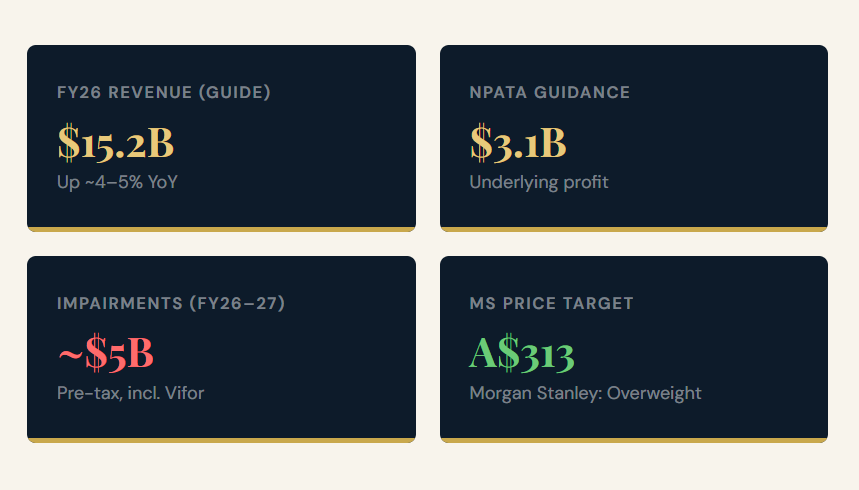
| Metric | FY26 Guidance | YoY Change |
|---|---|---|
| Group Revenue | ~A$15.2 billion | +4% to +5% |
| NPATA (Underlying Profit) | ~A$3.1 billion | +7% to +10% |
| Pre-tax Impairments (FY26–27) | ~A$5 billion | Non-cash write-down |
| Revenue Impact (Headwinds) | ~A$150 million | Geopolitical / product |
| US Capital Investment | A$1.5 billion new | 300+ new jobs |
One area of genuine optimism is CSL Behring, the plasma products and immunoglobulin division. Management expects second-half FY26 revenue growth here, driven by strong underlying IG demand and the benefits of a $500 million-plus cost savings and transformation programme.
CSL Seqirus: a stabilising force
The vaccine business has been a source of uncertainty following weaker US immunisation rates and the decision to indefinitely defer a planned Seqirus demerger. However, CSL has indicated Seqirus performance in H2 FY26 is expected to be “moderately stronger” than the market had anticipated. Longer term, Seqirus holds genuine strategic advantages through cell-based influenza vaccine technology, advanced products including aTIVc, and international expansion opportunities.
“Influenza market complexity enables strategic differentiation — growth will be driven by advanced vaccine technologies and a customer-focused approach, especially with new products and international expansion.”CSL management commentary, FY26
CSL’s $1.5 billion US investment: a long-term signal
CSL has announced a new $1.5 billion investment in its US operations, building on over $3 billion already deployed in the United States since 2018. This expansion will create at least 300 new jobs and focuses on enhancing plasma-derived therapy production capacity. This is not the behaviour of a company in structural decline — it signals board and management conviction in the long-term demand for plasma therapies, a market underpinned by an ageing global population and limited competition due to the highly complex nature of plasma processing.
What are analysts saying?
| Firm | Rating | Price Target | Key Comment |
|---|---|---|---|
| Morgan Stanley | Overweight | A$313 | Solid revenue growth & margin recovery for Behring |
| Canaccord Genuity | Buy | A$225 | Upgraded from Hold; AGM downgrade primarily Seqirus-driven |
| Consensus (27 analysts) | Broadly positive | ~A$229–$233 | Recent pullback seen as a re-entry opportunity |
Leadership transition
The global search for a new CEO is ongoing. Current CEO Paul McKenzie will remain on the CSL board as a non-executive director following the transition. Chief Commercial Officer Andy Schmeltz is retiring, with Diego Sacristan stepping up for CSL Behring. Leadership transitions carry inherent uncertainty but can also represent moments of strategic reset — a new CEO with a fresh mandate could accelerate execution on cost savings and capital allocation.
Key risks to monitor
Ongoing — FY26–27
Impairment finalisation: The ~$5 billion figure is not yet finalised. Further adjustments are possible once audit and board approval are complete.
Near-term
CEO appointment: Uncertainty around leadership succession could weigh on sentiment until a new CEO is named and strategy confirmed.
Ongoing
CSL Vifor headwinds: Middle East conflict exposure, HEMGENIX competition, and iron deficiency market dynamics continue to create revenue uncertainty.
FY27 & beyond
Seqirus recovery: US immunisation rate recovery is expected but not guaranteed. The pace will materially affect Seqirus revenue.
Structural
Currency risk: With roughly half of CSL’s revenue in North America, Australian dollar strength is a consistent earnings headwind.
CSL and your superannuation strategy
For Australian investors managing their own superannuation through an SMSF, the CSL situation highlights a broader principle: quality companies do go through periods of operational difficulty and share price weakness. The question is whether those challenges are cyclical and manageable, or structural and permanent.
CSL’s challenges appear, by and large, to be cyclical. Plasma demand is structurally strong, immunoglobulin growth in the high single digits is expected to continue, and the company’s global manufacturing scale creates durable competitive advantages that are almost impossible to replicate. Whether CSL belongs in your portfolio — and at what weighting — depends on your asset allocation, risk profile, and investment horizon. Understanding the evolving legislative landscape for your retirement savings is equally important: see our guide on Superannuation Changes 2026 for a full breakdown of what’s shifting this financial year.
The bottom line
CSL remains one of the most globally significant companies to emerge from Australia. Its business addresses fundamental and growing healthcare needs worldwide. The current period is undeniably difficult — a $5 billion impairment, CEO transition, Vifor underperformance, and a share price trading well below analyst targets create real uncertainty. But the underlying business continues to generate billions in annual revenue, guidance has been maintained, and the company is investing heavily in future production capacity.
For long-term investors, the key question is not what CSL’s share price is doing today — it is whether CSL will be a larger, more profitable business in five to ten years. On that measure, the structural case remains compelling.