
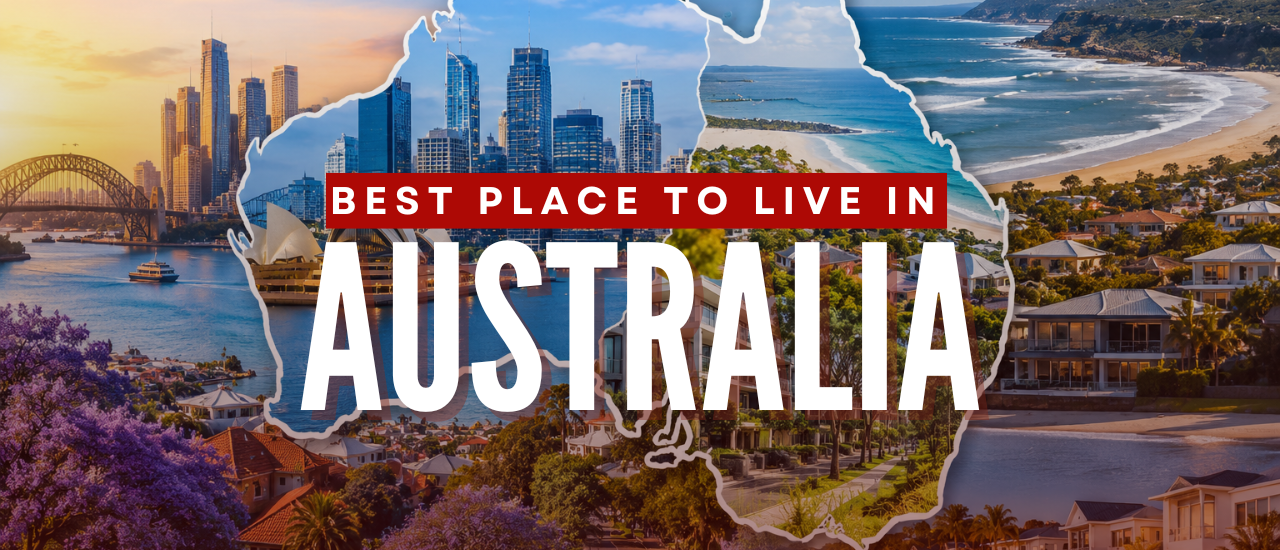
Australia has long held a reputation as one of the most desirable countries in the world to call home. With its world-class healthcare, outstanding public education, diverse natural environments, and a cultural scene that punches well above its weight globally, it is little wonder that millions of people — both locals and international migrants — are constantly asking the same question: what is the best place to live in Australia?
The honest answer is that there is no single winner. The right city for you depends on your career, your budget, your family situation, your appetite for city life versus coastal calm, and the lifestyle you want to build. What this guide does is lay out the facts — the costs, the culture, the job markets, the climate — so you can make a fully informed decision about where to plant your roots.
Whether you are a young professional chasing opportunity, a family looking for safe neighbourhoods and good schools, a retiree wanting a relaxed coastal life, or an expat arriving for the first time, Australia has a city that fits. Let us walk through all of them.
Why Australia Consistently Tops Global Liveability Ranking
Before diving into individual cities, it is worth understanding why Australia keeps appearing at the top of global surveys. The Economist Intelligence Unit (EIU) Global Liveability Index 2025 placed Melbourne at number four worldwide, with Sydney, Adelaide, and Brisbane also appearing in the global top ten. These rankings are based on five key pillars: stability, healthcare, culture and environment, education, and infrastructure.
Australia scores particularly well because of its universal healthcare system (Medicare), its network of high-ranking universities, its low crime rates relative to other developed nations, and its sheer geographic diversity — from alpine regions to tropical rainforests to pristine beaches. The country’s strong economy, with projected wage growth of around 4.5% and the creation of hundreds of thousands of new jobs in tech, renewable energy, and tourism, also makes it an attractive destination for those seeking long-term financial stability.
Naturally, where you live in Australia will significantly shape your financial journey. If you are planning a move — especially as an expat or investor — working with Trusted wealth management in Australia can help you structure your finances wisely as you settle into your new home.
The Best Places to Live in Australia: City-by-City Breakdown
1. Melbourne — Australia’s Most Liveable City Overall
Melbourne has earned its title as the best place to live in Australia for the broadest range of people, and it continues to hold that title in 2026. Ranked fourth in the world on the EIU Global Liveability Index 2025, it scores extraordinarily well across culture, infrastructure, healthcare, and education. With a population of around 5.5 million, it is a large, cosmopolitan city that somehow retains the feel of a collection of distinct, walkable neighbourhoods.
What makes Melbourne so compelling is the density of its everyday amenities. The tram network — the largest in the world — makes it genuinely easy to live without a car in many suburbs. The food and coffee scene is globally celebrated, with laneway cafés and multicultural restaurants around every corner. The arts, music, and sport culture is deeply embedded in daily life, from AFL football at the MCG to the Australian Open each January.
Families are drawn to suburbs like Glen Waverley and Camberwell for their excellent schools, while young professionals gravitate toward Fitzroy, Northcote, and Collingwood for the creative, café-heavy culture. Retirees and those seeking a bayside lifestyle often settle in Elwood or Brighton.
| Category | Melbourne at a Glance |
|---|---|
| EIU Global Liveability Rank (2025) | #4 worldwide |
| Median Weekly House Rent (2025) | ~AUD $600 |
| Median Weekly Unit Rent (2025) | ~AUD $550 |
| Median Salary | ~AUD $85,000 |
| Climate | Four seasons; winters 6–12°C, summers 25–35°C |
| Best For | Families, creatives, students, culture seekers |
The one drawback Melbourne-sceptics will point to is the weather. Winters can be grey and chilly, dipping to around 6°C, and Melburnians often joke that you can experience four seasons in one day. That said, most residents consider the mild summers, the autumn colour, and the slower winter rhythm to be a fair trade for the city’s extraordinary cultural richness.
2. Sydney — The Harbour City for Ambitious Professionals
Sydney is the city that needs little introduction. Its harbour, its Opera House, Bondi Beach — these are images that represent Australia to the world, and living here genuinely does feel like inhabiting a postcard. Ranked seventh in the world on the 2025 EIU Liveability Index and 15th on Time Out’s best cities list, Sydney combines global-city ambition with coastal lifestyle in a way few cities on earth can match.
Sydney’s economy is the largest in Australia, driven by finance, technology, healthcare, and creative industries. It offers the highest average salaries in the country and draws international talent at a scale that makes it one of the most internationally diverse cities in the Southern Hemisphere — around 43% of its 5.3 million residents were born outside Australia.
The lifestyle is genuinely impressive. Around 400 public parks, world-famous beaches including Bondi and Manly, a reliable ferry network running across the harbour, and a dining scene that rivals any city on earth. The $20 billion WestConnex infrastructure project, now substantially complete, has meaningfully improved road connectivity across the city.
| Category | Sydney at a Glance |
|---|---|
| EIU Global Liveability Rank (2025) | #7 worldwide |
| Median Weekly House Rent (2025) | ~AUD $750–800 |
| Median Weekly Unit Rent (2025) | ~AUD $650 |
| Median Salary | Highest in Australia |
| Climate | Warm, mild; 18–26°C year-round averages |
| Best For | Professionals, expats, beach lovers |
The significant downside is cost. Sydney is by some distance the most expensive city in Australia to rent or buy property in. For those not on high salaries, housing pressure can feel relentless. This is worth weighing carefully before choosing Sydney as your destination.
3. Brisbane — The Rising Star of Australian Cities
Brisbane has undergone a remarkable transformation over the past decade and is now widely considered one of the best places to live in Australia for families and young professionals who want a balance of affordability, lifestyle, and career opportunity. The city jumped to 16th globally in recent liveability surveys, and its reputation has never been higher.
With a warm subtropical climate (an average of 24°C), an average cost of living roughly 20% below Sydney’s, and a booming economy driven by mining, technology, and the upcoming infrastructure investments tied to the 2032 Brisbane Olympics, the city is in a particularly exciting growth phase. The Queen’s Wharf precinct, opened in 2026, has added a major luxury dining and entertainment hub to the riverside, and suburbs like New Farm, West End, and Paddington have developed sophisticated food and cultural scenes.
Families particularly appreciate South Bank — Brisbane’s cultural and recreation hub on the riverfront — with free pools, playgrounds, the Queensland Museum, and walking paths that make weekend life genuinely easy and enjoyable.
| Category | Brisbane at a Glance |
|---|---|
| EIU Global Liveability Rank (2025) | #16 worldwide |
| Average Cost Compared to Sydney | ~20% cheaper |
| Median Salary | ~AUD $82,000 |
| Climate | Subtropical; warm year-round, mild winters |
| Best Suburbs for Families | South Bank, New Farm, Paddington |
| Best For | Families, young professionals, outdoor lovers |
4. Adelaide — The Most Underrated City in Australia
If you have never lived in Adelaide, you may be underestimating it. Adelaide consistently appears in global top-ten liveability lists, and yet it tends to fly under the radar compared to Sydney, Melbourne, and Brisbane. This is actually one of its greatest strengths — it is a city that delivers exceptional quality of life without the price tag or the frantic pace of the larger capitals.
Adelaide is regularly described as one of the cheapest but nicest places to live in Australia. Housing is significantly more affordable than in Sydney or Melbourne, the traffic is comparatively manageable, and the city’s layout — a grid surrounded by parklands — gives it a spacious, unhurried feel. The Barossa Valley, McLaren Vale, and other world-class wine regions are within an hour’s drive. The coastline at Glenelg is accessible by tram in under 30 minutes from the CBD.
The city is internationally celebrated for its festival culture, including the Adelaide Fringe (the world’s second-largest arts festival) and WOMADelaide. Its food and wine credentials are genuinely world-class.
| Category | Adelaide at a Glance |
|---|---|
| EIU Global Liveability Rank (2025) | Top 10 worldwide |
| Housing Affordability | Significantly more affordable than Sydney/Melbourne |
| Climate | Mediterranean; hot summers, mild winters |
| Key Lifestyle Draws | Wine regions, festivals, beaches, slow pace |
| Best For | Families, retirees, creatives, those prioritising affordability |
The main limitation is a smaller job market. Adelaide does not offer the same breadth of career opportunities as Sydney or Melbourne, particularly in finance and technology. However, for those whose work is flexible or remote, this is increasingly a non-issue.
5. Perth — Sun, Space, and a Postcard Coastline
Perth is the most geographically isolated major city in the world — a fact that is both its challenge and its charm. What Perth offers in return for that isolation is extraordinary: pristine white-sand beaches, Mediterranean-style sunshine (29°C average in summer), a rich mining-driven economy, and a quality of life that is widely underappreciated.
Ranked 31st on the 2025 EIU Liveability Index, Perth sits approximately 15% below Sydney in terms of cost of living, and offers a lifestyle that is fundamentally built around the outdoors — cycling paths, surf beaches, river walks, and endless weekend escapes up the coast to places like Rottnest Island (just a one-hour ferry away, and famous for its quokka inhabitants).
The economy is robust, driven heavily by the resources and mining sectors, and the jobs market is solid for those with relevant skills. The Swan Valley wine region is another lifestyle asset that Perth residents enjoy.
| Category | Perth at a Glance |
|---|---|
| EIU Global Liveability Rank (2025) | #31 worldwide |
| Cost of Living vs Sydney | ~15% cheaper |
| Climate | Mediterranean; long, sunny summers |
| Key Industries | Mining, resources, healthcare, construction |
| Best For | Outdoor lovers, families, those seeking space |
6. Canberra — The Safest and Most Educated City in Australia
Canberra is Australia’s purpose-built capital, and it is often one of the most overlooked answers to the question of where is the best place to live in Australia. It consistently ranks as the safest major city in Australia, with low crime rates and well-resourced public infrastructure across its well-planned suburbs.
What most surprises people who move to Canberra is the quality of life. It has the highest median household income in Australia, a well-functioning public transport network, outstanding schools, and proximity to both the Snowy Mountains (for skiing) and the South Coast beaches (for summer). The city is compact enough that traffic congestion is minimal, and the public sector-dominated economy provides considerable job stability.
| Category | Canberra at a Glance |
|---|---|
| Safety | Consistently Australia’s safest capital city |
| Median Household Income | Highest of any Australian capital |
| Climate | Four seasons; cool winters, warm dry summers |
| Key Employers | Federal government, education, research, defence |
| Best For | Families, public servants, those seeking stability |
7. Gold Coast and Sunshine Coast — Best for Coastal Family Living
For those whose priority is a beach lifestyle combined with family-friendly infrastructure, the Gold Coast and Sunshine Coast in South East Queensland represent the most compelling options. Both cities sit within commuting or easy driving distance of Brisbane, offering the lifestyle advantages of a coastal city at a somewhat more accessible price point than Sydney’s northern beaches.
The Gold Coast is a city of 600,000+ people with a well-developed economy, strong tourism sector, excellent surf beaches, and a growing technology hub around Varsity Lakes and Robina. The Sunshine Coast — quieter, greener, and more relaxed — appeals to families and retirees who want natural beauty, a slower pace, and a genuine community feel.
Comparing the Best Australian Cities Side by Side
The table below gives a direct comparison of the key livability factors across Australia’s major cities, to help you quickly assess which city best suits your priorities.
| City | EIU Rank (2025) | Avg. Weekly Rent (House) | Climate | Best For | Relative Affordability |
|---|---|---|---|---|---|
| Melbourne | #4 world | ~AUD $600 | Four seasons | Culture, families, students | Moderate |
| Sydney | #7 world | ~AUD $750–800 | Warm & mild | Professionals, expats | Most expensive |
| Brisbane | #16 world | ~AUD $550–600 | Subtropical | Families, young pros | Good value |
| Adelaide | Top 10 world | ~AUD $480–520 | Mediterranean | Affordability, lifestyle | Very affordable |
| Perth | #31 world | ~AUD $530–560 | Mediterranean | Outdoors, families | Affordable |
| Canberra | Top 20 nationally | ~AUD $580–620 | Continental | Safety, stability | Moderate |
| Gold Coast | — | ~AUD $620–650 | Subtropical | Beach life, families | Moderate |
What to Consider When Choosing the Best Place to Live in Australia
Choosing the right city goes beyond simply picking the one with the best liveability score. There are several practical factors that should guide your decision.
Career and employment is arguably the most important consideration for working-age migrants and locals. Sydney leads for finance, technology, and media. Melbourne is strong across healthcare, education, finance, and the arts. Brisbane and Perth are excellent for resources, construction, and emerging tech. Canberra is dominated by government and research roles.
Housing costs and affordability vary dramatically across the country, and your budget will significantly constrain your options. Sydney and Melbourne’s inner suburbs have among the highest property prices in the world relative to income. Brisbane, Adelaide, and Perth offer far better value for families looking to buy.
Climate preference is a deeply personal factor. Sydney and the Queensland cities offer warm weather almost year-round. Melbourne and Canberra experience genuine winters. Adelaide and Perth have long, dry, Mediterranean summers that suit many people perfectly.
Schools and education are excellent across all major Australian cities, with six Australian universities ranked in the QS World Top 100. Specific suburbs within each city, however, vary considerably in terms of public school quality and access to selective schools.
Final Verdict: What Is the Best Place to Live in Australia?
If forced to name a single best place to live in Australia, Melbourne earns that title for the widest range of people. Its balance of culture, infrastructure, healthcare, education, job diversity, and lifestyle is unmatched. But the reality is that each major Australian city serves a different kind of resident exceptionally well. Sydney suits those chasing career peak performance and prestige. Brisbane is emerging as the most exciting city for families seeking affordability without sacrificing modern urban amenity. Adelaide is the best-kept secret for those prioritising cost of living and lifestyle quality. Perth rewards those who want space, sunshine, and a beach at the end of the road.
No matter which city you choose, Australia rewards those who plan their financial lives wisely. For new residents, expats, and investors navigating property, taxation, and wealth-building in a new country, working with Trusted wealth management in Australia from the outset can make a meaningful difference to your long-term outcomes.
Frequently Asked Questions About the Best Place to Live in Australia
Q: What is the overall best place to live in Australia in 2026? Melbourne is widely considered the best place to live in Australia overall in 2026, ranking fourth in the world on the EIU Global Liveability Index. It offers the strongest balance of culture, education, healthcare, public transport, and job diversity. However, Sydney is the better choice for those prioritising career growth and earning potential, while Brisbane and Adelaide are increasingly popular for families prioritising affordability.
Q: What is the cheapest but nicest place to live in Australia? Adelaide is consistently ranked as the cheapest but nicest place to live in Australia. It offers a Mediterranean climate, world-class festivals and wine regions, excellent schools, and a relaxed pace of life at a cost of living significantly below Sydney and Melbourne. Geelong and Newcastle are also worth considering as more affordable alternatives to the major capitals.
Q: What is the safest city to live in Australia? Canberra is widely considered the safest major city in Australia, with consistently low crime rates and well-resourced public infrastructure. Australia as a whole ranks very well for personal safety in global comparisons, and even the largest capitals like Melbourne and Sydney are safe by international standards.
Q: Is Brisbane or Melbourne better to live in? It depends on your priorities. Melbourne offers greater cultural richness, a more established food and arts scene, and a larger, more diverse job market. Brisbane offers warmer weather, lower cost of living (roughly 20% cheaper), more outdoor lifestyle opportunities, and an economy that is growing rapidly ahead of the 2032 Olympics. For families on a budget who enjoy outdoor living, Brisbane edges ahead. For culture, career, and urban sophistication, Melbourne wins.
Q: Is Perth a good place to live in Australia? Yes, Perth is an excellent place to live, especially for those who value outdoor lifestyle, sunshine, beaches, and a slower pace than the east coast capitals. It is approximately 15% cheaper than Sydney, has a solid economy based on mining and resources, and offers access to some of the most pristine beaches and coastline in the world. The main downside is its geographic isolation from other Australian cities.
Q: What is the best place to live in Australia for families? Brisbane, Adelaide, and Canberra are consistently cited as the best places in Australia for families. Brisbane offers warmth, outdoor space, excellent schools, and strong community infrastructure. Adelaide provides affordability, clean air, low congestion, and a relaxed lifestyle. Canberra gives families outstanding schools, safety, and high household incomes in a compact and well-planned city environment.
Q: Is Australia a good place to live overall? Absolutely. Australia is one of the most liveable countries on earth, consistently placing multiple cities in the global top ten for liveability. Universal healthcare via Medicare, strong public education, low crime relative to most developed nations, beautiful natural environments, and a multicultural, welcoming society make it a genuinely exceptional place to build a life.
Q: What Australian city has the highest salaries? Sydney has the highest average salaries of any Australian city, reflecting its role as the country’s financial and commercial capital. Canberra, however, has the highest median household income nationally, largely due to the concentration of well-paid government and research roles.