
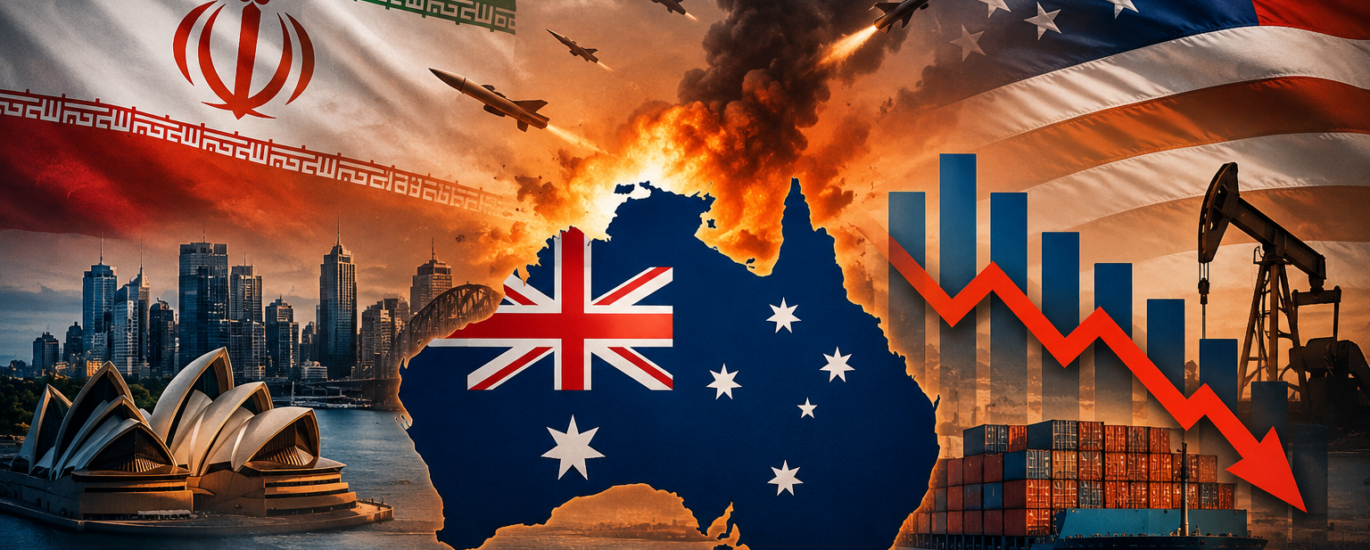
Since fighting broke out between the United States, Israel and Iran on 28 February 2026, the shockwaves have travelled far beyond the Middle East. Despite sitting more than 11,000 kilometres away, Australia has felt the conflict through petrol bowsers, grocery bills, mortgage repayments and superannuation balances. A ceasefire brokered in April, followed by a formal Memorandum of Understanding signed in June, briefly calmed markets — but as of early July 2026, renewed strikes between the US and Iran have thrown the truce into doubt, and Australian households and businesses are once again bracing for impact.
This article breaks down exactly how the conflict has flowed through to the Australian economy, backed by the latest data from the Reserve Bank of Australia (RBA), the Australian Bureau of Statistics (ABS), the Federal Treasury and leading economists.
A Quick Recap: How We Got Here
- 28 February 2026 – The US and Israel launched joint strikes on Iran, targeting nuclear facilities and military leadership, igniting the war.
- 8 April 2026 – A fragile two-week ceasefire was agreed, mediated by Pakistan, though it was repeatedly tested by both sides.
- 12–13 April 2026 – Peace talks in Islamabad collapsed, prompting the US to impose a naval blockade on Iran.
- 17 June 2026 – The US and Iran signed a Memorandum of Understanding in Versailles to formally end the war, and the Strait of Hormuz reopened.
- 8–9 July 2026 – The truce unravelled after Iran allegedly struck commercial tankers in the Strait of Hormuz. The US responded with fresh airstrikes, and President Trump declared the ceasefire “over,” reinstating sanctions and a naval blockade.
This on-again, off-again pattern of conflict and de-escalation is exactly why Australian economic data has been so volatile in 2026 — every flare-up sends oil prices, inflation forecasts and interest rate expectations swinging.
1. Oil Prices and the Strait of Hormuz
Roughly a fifth of the world’s oil and gas passes through the Strait of Hormuz. When Iran threatened — and at times restricted — shipping through the strait, global energy markets reacted immediately.
- Brent crude jumped from around US$70 a barrel before the war to above US$108 a barrel during the worst of the disruption.
- Analysts at Goldman Sachs lifted their year-end Brent forecast from US$80 to US$90 a barrel, assuming Gulf exports gradually normalise.
- Modelling from Oxford Economics found that in a prolonged conflict scenario, oil could stay above US$150 a barrel for months, alongside shortages of refined fuel products.
Because Australia imports the vast majority of its refined fuel, it pays world prices at the bowser. A US$40 a barrel increase in crude has historically added around 40 cents a litre to Australian petrol prices — a direct hit to household budgets and business transport costs.
2. Inflation: The Biggest Domestic Impact
Fuel is the fastest-moving channel through which the war has affected everyday Australians, but it hasn’t stopped there. Higher shipping and freight costs have pushed up the price of imported goods, fertiliser and food, while LNG price rises have added to household energy bills.
| Indicator | Pre-War Baseline | Peak / Latest 2026 Reading |
|---|---|---|
| Headline CPI (annual) | ~2.4% (late 2025) | 4.6% (March quarter 2026) |
| Trimmed mean (underlying) inflation | ~3.0% | 3.4%–3.9% (mid-2026) |
| Automotive fuel prices | Stable | +32.8% in a single month (March 2026) |
| Electricity prices (YoY) | Modest | +25.4% (March 2026, partly rebate expiry) |
| RBA cash rate | 3.60% (after 2025 rate cuts) | 4.35% (June 2026) |
Federal Treasurer Jim Chalmers confirmed that Treasury’s own modelling estimated the war could add between 0.5 and 1.25 percentage points to headline inflation, while shaving 0.2 to 0.6 percentage points off GDP growth. Some economists have warned everyday households could end up paying up to 20% more for essentials if the conflict drags on much longer.
3. Interest Rates and Household Budgets
After cutting rates three times in 2025, the RBA was forced into an abrupt about-turn. Facing fuel-driven inflation on top of already-elevated domestic price pressures, the Board delivered three consecutive rate hikes in early 2026, taking the cash rate back to 4.35%. Markets are currently pricing in a further move towards 4.70% by the end of the year if the conflict re-escalates.
This matters directly for anyone with a mortgage. Higher rates on top of higher living costs have been a double blow — the RBA itself has flagged that more than 1.6 million Australian households were showing signs of mortgage stress by mid-2026.
4. The ASX and Investment Markets
Sharemarkets are highly sensitive to geopolitical headlines, and the ASX 200 has been on a rollercoaster ride throughout 2026.
| Event | ASX 200 Reaction |
|---|---|
| Outbreak of war (28 Feb 2026) | Sharp sell-off, index down more than 8% from early-March highs |
| Trump floats 5-day ceasefire (23 Mar 2026) | ASX rallies almost 2% in a single session as oil fell over 10% |
| Signing of MoU (17 June 2026) | Relief rally as Strait of Hormuz reopens |
| Ceasefire collapse (8–9 July 2026) | Renewed volatility as oil prices climb again |
Energy and mining stocks have generally benefited from higher commodity prices, while consumer discretionary, transport and import-reliant sectors have come under pressure from rising input costs and softer consumer spending.
5. Winners and Losers Across the Australian Economy
The war hasn’t hit every part of the economy equally. As a net oil importer but major LNG and coal exporter, Australia has faced an unusual mix of pain and gain.
| Sector / Group | Impact | Why |
|---|---|---|
| Households & consumers | Negative | Higher fuel, energy and grocery costs; rising mortgage repayments |
| Transport & logistics | Negative | Directly exposed to fuel price spikes |
| Manufacturing | Negative | Higher input and freight costs |
| Agriculture | Mixed to negative | Fertiliser prices more than doubled; tough trade-off between cost and crop yield |
| LNG & energy exporters | Positive | Benefited from higher global gas and oil prices |
| Iron ore & mining exporters | Mixed | Supported by energy prices, but weighed down by softer Chinese demand |
| Import-reliant retailers | Negative | Higher shipping costs, supply chain disruption |
| State/regional economies | Varies | Commodity-export-heavy states more exposed to volatility; diversified, populous states more insulated |
6. Government and RBA Response
The Federal Government activated elements of Australia’s national fuel security plan and faced calls from energy researchers to escalate to a higher preparedness tier as service stations experienced temporary shortages linked to panic buying. The RBA, for its part, has repeatedly stressed that supply shocks like this are difficult to manage with monetary policy alone — hiking rates too aggressively risks unnecessary damage to growth and employment, while doing too little risks letting inflation expectations become entrenched.
Governor Michele Bullock has acknowledged the RBA is watching the situation “very closely,” noting that a short-lived shock and a prolonged one call for very different policy responses.
7. What Could Happen Next
With the ceasefire declared “over” by President Trump in early July 2026 and fresh strikes exchanged between the US and Iran, the path forward remains highly uncertain. Economists broadly agree on two scenarios:
- Quick resolution – If a durable peace deal is reached, oil prices should ease, inflation gradually returns towards the RBA’s 2–3% target band, and confidence and spending recover through 2027.
- Prolonged or re-escalating conflict – A drawn-out war could push oil above US$150 a barrel, drive Australian inflation well above 5%, and increase the risk of recession, with some forecasts suggesting GDP could contract and unemployment could climb above 9% in a worst-case scenario.
What This Means for Your Finances
Geopolitical shocks like the Iran-US war are a reminder that global events can have a very real, very local impact on your cost of living, your mortgage, and your investment portfolio. During periods of heightened uncertainty, it’s tempting to make reactive decisions — but history shows that well-diversified portfolios and sound financial planning tend to weather these storms far better than panic-driven changes.
If you’re unsure how these developments might affect your personal financial position, speaking with a professional can help you separate short-term noise from long-term strategy. The team at Trusted wealth management in Australia can help you review your portfolio, hedge against volatility, and stay on track with your financial goals no matter how global events unfold.